React vs. Vue vs. Angular: Which Framework is Right for Your Next Project?

Choosing the right JavaScript framework is the most critical decision you’ll make when developing a modern, scalable website. The framework dictates performance, development speed, and long-term maintainability.
If you’re partnering with a Web Designing Company in Kochi for a new web application or a complex portal, you’ll likely encounter three major players: React, Vue, and Angular. While all three are powerful tools, their philosophies and best-use cases differ significantly.
Here’s a breakdown to help you decide which framework is the best fit for your next project with a Web Design Kochi team:
1. React: The Flexibility King (Library, not a Framework)
Often referred to as a “library” rather than a full framework, React is maintained by Facebook and remains incredibly dominant worldwide.
- Best For: Large-scale applications, single-page applications (SPAs), complex UIs, and projects requiring high flexibility.
- Key Feature: The Virtual DOM (Document Object Model). React creates a lightweight copy of the actual DOM, which allows it to update only the specific elements that have changed. This results in superior performance and a snappier user experience.
Pros:
- Vast Ecosystem: A massive community means more tutorials, readily available packages, and extensive third-party tools.
- Flexibility: It offers freedom in choosing libraries for routing, state management, and tooling (e.g., Redux, MobX).
- Strong Talent Pool: Finding skilled React developers is relatively easy for any Website Design Company in Kochi.
Cons:
- Steeper Learning Curve: Because it’s a library, you need to select and integrate external tools yourself, leading to more initial setup complexity.
2. Angular: The Enterprise Standard (Full Framework)
Maintained by Google, Angular is a full, opinionated, batteries-included framework. It provides structure, clear conventions, and all the tools needed for enterprise-level development.
- Best For: Large-scale, highly structured applications, enterprise solutions, and projects where standardization and stability are paramount.
- Key Feature: Two-way Data Binding. This means changes in the model (data) are automatically reflected in the view (UI) and vice-versa, significantly reducing boilerplate code for forms and data presentation.
Pros:
- Built-in Structure: Everything from routing to state management is provided out-of-the-box, enforcing consistency across large teams.
- TypeScript Focus: It relies heavily on TypeScript, which adds strong typing and makes large codebases easier to refactor and debug.
- Reliability: Due to its structure and backing by Google, it’s often favored for long-term, high-stakes corporate applications.
Cons:
- Verbose and Complex: Angular has a much steeper learning curve than React or Vue due to its many modules, concepts (like Modules, Components, Services), and structure.
- Performance: Angular’s Change Detection, while powerful, can sometimes be slower than React’s Virtual DOM.
3. Vue.js: The Gentle All-Rounder (Progressive Framework)
Vue.js is the youngest of the three and has gained popularity for its gentle learning curve and elegant simplicity. It’s often called a “progressive framework,” meaning you can use it to enhance a small part of a page or build a complex Website Design Company Kochi application.
- Best For: Small to medium-sized projects, rapid prototyping, and integrating into existing websites or legacy systems.
- Key Feature: Simplicity and Integration. Vue is designed to be easily accessible to beginners with clean syntax and excellent documentation.
Pros:
- Shallow Learning Curve: Developers proficient in standard HTML, CSS, and JavaScript can pick it up very quickly.
- Excellent Documentation: Vue boasts arguably the best, most comprehensive, and easiest-to-read documentation.
- Performance: It uses a Virtual DOM like React and offers excellent speed.
Cons:
- Smaller Ecosystem: Compared to React or Angular, Vue has a slightly smaller community and fewer third-party libraries.
- Less Corporate Backing: While stable, it doesn’t have the immense corporate backing of Google or Meta.
The Verdict for Your Next Project
The right choice depends entirely on your project’s DNA. Here’s a quick summary for when you consult your Web Design Company:
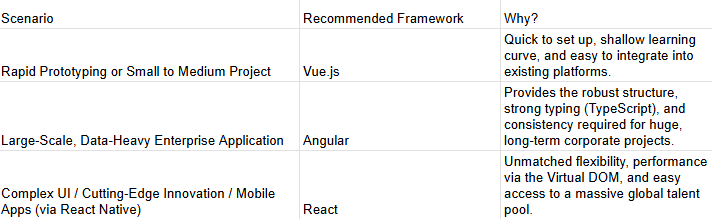
When you choose a Web Design Company Kochi, ensure they have expertise across all these frameworks to advise you on the tool that perfectly matches your business goals, budget, and scalability needs.


Comments
Post a Comment